

As previously announced after the February CCMTA Board of Directors meeting, the Board has been working diligently to revamp CCMTA’s organizational structure and has expanded its Program Committee structure from three to five Program Committees.
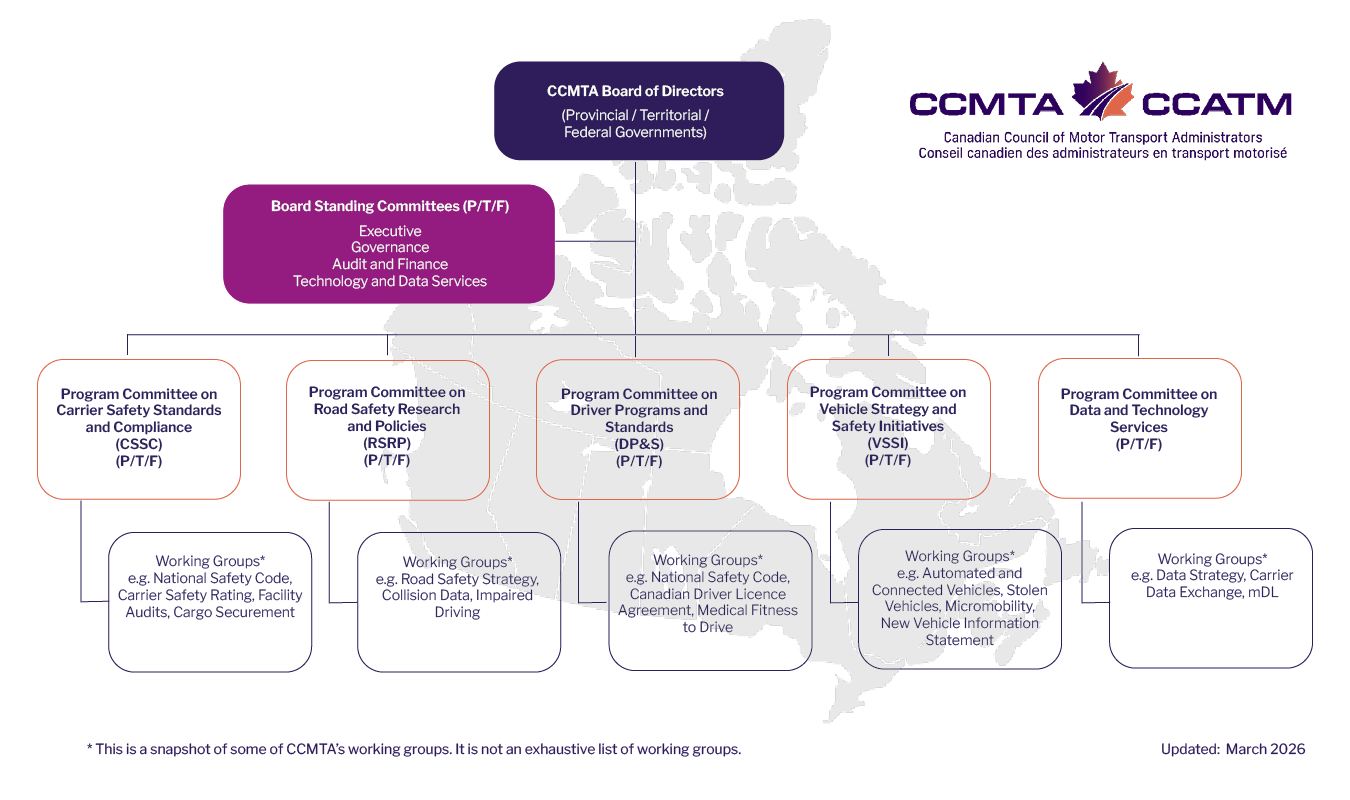
Program Committees provide a forum for jurisdictional collaboration and knowledge sharing on research and policy matters, and they identify and address emerging road safety issues. They develop and coordinate the implementation of modern and consistent standards, practices and priorities and contribute to the implementation of Canada’s road safety strategies ensuring the safe and efficient movement of people and goods by road.
Each of the Program Committees may be comprised of up to two representatives from each of Canada’s 14 provincial, territorial and federal governments, responsible for transportation and highway safety.
These Program Committees build capacity, help to profile CCMTA initiatives as a national entity in road safety, and establish processes to ensure CCMTA is best in class in managing data. Each of the five Program Committees will work towards addressing critical areas within CCMTA’s mandate — drivers, vehicles, data and technology, commercial motor vehicles and carriers, and road safety research. Here’s a high-level overview of each committee:
The Carrier Safety Standards and Compliance (CSSC) Program Committee focuses on:
- Commercial vehicles, drivers, and carrier operations in Canada and internationally.
- Providing oversight for National Safety Code (NSC) Standards within the Committee’s scope, ensuring they are maintained and periodically reviewed to remain effective and responsive to industry needs, technology and regulatory changes.
- Providing leadership and guidance to the Commercial Vehicle Safety Alliance (CVSA) Region V.
The Carrier Safety Standards and Compliance Program Committee’s current priorities include:
- Proposing changes and a path forward for NSC Standards 7 (Carrier and Driver Profiles), 14 (Safety Ratings), and 15 (Facility Audits).
- Identify opportunities to coordinate national effort to address the misclassification of commercial drivers (Driver’s Inc.).
- Determining the data requirements for the modernization of the Carrier Data Exchange (CDE) system.
- Undertaking a data-driven study to assess the effects of adjusting weight thresholds on safety, compliance, and regulatory burdens.
Chair: Michael Kasprzak, Yukon
Vice Chair: Jennifer Elliott, Ontario
CCMTA Staff Liaison: Mariline Jean Louis, Programs Manager
The Driver Programs and Standards (DP&S) Program Committee focuses on:
- Providing leadership for driver safety and licensing in Canada and internationally, including governance of the Canadian Driver’s License Agreement (CDLA) and related administrative guides.
- Providing strategic oversight and governance of the Driver Fitness Overview Group (DFOG) to ensure uniform medical drivers fitness standards and evidence-based practices across jurisdictions and focusing on high-level objectives such as maintaining NSC 6 Medical Standards, promoting evidence-based approaches, and ensuring consistency across jurisdictions.
- Providing oversight for National Safety Code standards within the Committee’s scope, ensuring they are maintained and periodically reviewed to remain effective and responsive to industry needs, technology, and regulatory changes.
The Driver Programs and Standards Program Committee’s current priorities include:
- Review and updates of the administration guide for the Canadian Drivers License Agreement (CDLA)
- Reviewing and updating the Conviction Equivalency Table (CET)
- Reviewing and updating the vision and hearing Standards withing NSC 6 (Determining Driver Fitness in Canada)
- The development of harmonization tools to help jurisdictions achieve consistent interpretation and implementation of NSC Standard 16 (Entry Level Training – Class 1)
Chair: Jacques Paquet, Québec
Vice Chair: Lisa King, Newfoundland and Labrador
CCMTA Staff Liaison: Sarah Gauen, Programs Manager
The Road Safety Research and Policies (RSRP) Program Committee focuses on:
- Coordinating and conducting research on contributing factors to serious injuries and fatalities on Canadian roads.
- Developing and promoting harmonized national approaches to road safety data collection, analysis, and use.
- Developing and supporting the goals of Canada’s Road Safety Strategy, including the advancement of the Safe Systems Approach.
- Identify emerging issues by proactively identifying and prioritizing research needs and policy gaps related to road safety.
The Road Safety Research and Policies Program Committee’s current priorities include:
- Manage the implementation, monitoring, and updates to Canada’s Road Safety Strategy 2035+
- Develop a comprehensive report that identifies current collision data sources in Canada, evaluates barriers and opportunities for improvement, and lays out a roadmap to harmonize collision data collection, sharing, and governance.
Chair: Bryce Doell, Manitoba
Vice Chair: Deborah Hagen, Prince Edward Island
CCMTA Staff Liaison: Katherine Clark, Programs Manager
NEW! The Data and Technology Services (DTS) Program Committee focuses on:
- Developing and ongoing management of a data strategy for CCMTA.
- Enhancing data sharing opportunities across jurisdictions.
- Providing guidance, coordination and project delivery on key data files including the Carrier Data Exchange (CDE) and mobile driver licences (mDLs).
- Partnering with industry and peer organizations to leverage knowledge and progress on key initiatives.
- Identifying current and emerging data/technology needs that supports road safety initiatives.
The Data and Technology Services Program Committee’s current priorities include:
- Development of a data strategy for CCMTA.
- Leveraging existing and building new capacity for the Carrier Data Exchange.
- Exploring how to move forward with mDLs.
- Exploring data sharing opportunities with partner organizations.
Chair: Kristin Ward-Diaz, Alberta
Vice Chair: Marc Faubert, Ontario
CCMTA Staff Liaison: Omar Ayyash, Programs Manager
NEW! The Vehicle Strategy and Safety Initiatives (VSSI) Program Committee focuses on:
- Providing leadership in vehicle safety and compliance initiatives in Canada and internationally, including governance of CCMTA endorsed agreements and guidelines related to vehicle programs.
- Providing strategic oversight of vehicle related compliance, safety, fraud, and theft initiatives.
- Providing oversight for National Safety Code standards within the Committee’s scope, ensuring they are maintained and periodically reviewed to remain effective and responsive to industry needs, technology, and regulatory changes.
The Vehicle Strategy and Safety Initiatives Program Committee’s current priorities include:
- Support ongoing activities related to the International Registration Plan (IRP).
- Re-establish an Automated/Connected Vehicle project group.
- Explore opportunities and recommend next steps on stolen vehicles.
- Explore opportunities and recommend next steps on micromobility.
Chair: Bradley Gerhart, British Columbia
Vice Chair: Amanda Doobay, Ontario
CCMTA Staff Liaison: Samantha Peek, Programs Manager
All Program Committees are accountable to the Board of Directors who provides oversight on committee work and reviews recommendations made by committee members. The CCMTA Board of Directors has created a governance framework to support its mandate and role. CCMTA’s governance framework is illustrated below:
To stay abreast of CCMTA’s activities, be sure to check back in on our Organizational News & Updates page and follow CCMTA on LinkedIn.


